
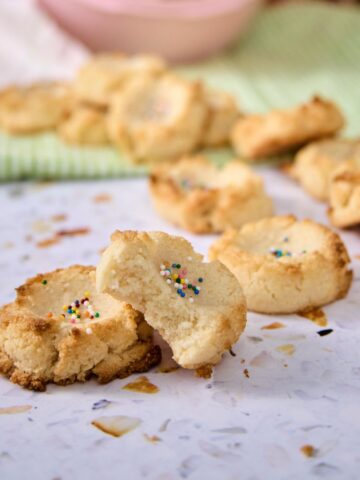
Polvorones or Mantecaditos are some of my favorite memories from growing up in Puerto Rico. They're our version of traditional Spanish shortbread cookies. Delicate, buttery, and mildly sweet, these jam or sprinkle-decorated cookies melt in your mouth, crumbling with each bite. Although these cookies are available at many stores, the BEST ones are homemade.

Polvorones are a Puerto Rican staple enjoyed year-round. During recreo (a free period for students to play), we used to go to the many houses selling treats and snacks and would buy six cookies for fifty cents, along with limbers de coco, coconut milk ice pops. We also used to buy empanadillas de carne or queso. They sure hit the spot.
Are you interested in more dessert ideas? Check out my Bread Pudding recipe. The bread is soaked in the custard, creating a velvety, dense texture. Puerto Rican Hojaldre: Do not let the name fool you; this is a delicious spice cake where cinnamon, cloves, and nutmeg are the stars of the show. For more limber ideas, try Creamy Limbers de Pistachio. And don't miss my Tropical Carrot Cake with Banana and Coconut. This carrot cake is moistened with pineapple and banana, the coconut enhances the tropical flavors, and the citrus cream cheese frosting balances them.
Jump To
Polvorones or Mantecaditos: What's in a name?
There is no straight answer, especially when it comes to Puerto Rican polvorones. These cookies are descendants of the ghraybeh, a shortbread from Arab cuisine that took root in Al-Andalus, the Moorish region of southern Spain, before being commercialized in the town of Estepa by Micaela Ruiz Téllez. In Spain, there are two main varieties: those made with ground almonds and dusted with powdered sugar (polvorones) and those without sugar (mantecados). They arrived in Puerto Rico through Andalusian and Canary Island immigrants, where lard was already a kitchen staple, but almonds were not. Cuba faced the same reality with their version, the tortica de Morón; almonds simply were not readily available in the Caribbean, so both islands adapted. Torticas de Morón are the closest version to Puerto Rican polvorones of all the variations outside of Spain. We dropped the almond flour and the powdered sugar, and the cookies became our own. The name polvorones draws on the idea that the cookie is dusted with powdered sugar (polvo means dust). Mantecados, or mantecaditos as we say in Puerto Rico, are named after the use of manteca de cerdo (pork lard) in the dough. But Puerto Rican polvorones are not dusted with powdered sugar, so why the name? Even in Spain, the names are used interchangeably, and it seems we learned to do the same. One more note: I say mantecaditos, not mantecados, because in many areas of Puerto Rico, myself included, a mantecado is ice cream, and that is a discussion for another day 😉.
Why you will love this recipe?
- Simple Ingredients, Big Reward: With just a few simple ingredients, polvorones are easy to make yet deliver a rich, satisfying flavor. They are perfect for beginner bakers or those who want to make something extraordinary without needing complex techniques.
- Creative Variations: Once you know the basics, polvorones are highly customizable. You can experiment with flavors like coconut, cinnamon, and lemon zest or even add colorful sprinkles or sugar coatings, making them delicious and visually appealing.
- Rooted in Puerto Rico: This is the Puerto Rican take on a cookie with centuries of history behind it. Here, we call them polvorones or mantecaditos, and both names refer to the same buttery cookie, topped with guava paste or grageas.
- Gift-Worthy: Homemade polvorones make thoughtful gifts, especially when packaged in a nice box or bag. They're an ideal treat to share with friends and family, symbolizing warmth and care.
Ingredient Notes

- Flour: Flour forms the structure of the polvorón, providing just enough gluten to create a cohesive yet crumbly cookie.
- Butter: Traditionally, a combination of butter and lard gives polvorones their tender, crumbly texture. I only use lard when it is readily available, so this recipe focuses on butter, though I will give you information on lard as well. The high fat content prevents excessive gluten development, keeping the cookie light and melt-in-the-mouth soft.
- Sugar: Sugar adds to the cookie's crispiness. Since not all the sugar crystals dissolve during baking, they contribute a subtle crunch to the polvorones.
See my recipe card below for a complete list of the ingredients with measurements.
About Lard:
Lard is the traditional ingredient in this recipe and is still used in Spain. I go back and forth between using lard and just butter. I never use vegetable shortening. Why? Because if I have to compare lard to vegetable shortening, the shortening requires stabilizers and manipulation to remain solid, whereas lard is a single-ingredient byproduct with minimal processing. If you are going to buy lard, here are a few tips:
- Never buy your lard from the shelf of an aisle in a major grocery store. These shelf-stable products tend to be hydrogenated and linked to trans fats, which we want to avoid.
- Please find a local farmer who renders fat from their pigs. Not only will you get a better, fresher product, but you will also be supporting your local community. I buy my lard from a reputable organic farm a few miles from home. The lard is rendered and canned in a mason jar at the farm, then kept refrigerated.
- Prevention has a great article on the use of lard and its health benefits.
- Beef tallow is harder and crisper than lard. It takes longer to soften and does not behave as creamily as pork lard. If you are planning on using tallow, cut the tallow amount in half and increase the butter ratio.
Variations and Substitutions
- Alternate Flours: My Low-carb polvorones are made with a combination of almond and coconut flours, which add a great deal of flavor to these cookies.
- Toasting the Flour: Toasting flour is part of the Estepa polvorón and mantecado tradition, adding warmth and nutty flavor while contributing to the signature sandy texture. Toasted flour also helps the polvorones crumble delicately when eaten.
- Alternate Fats: Experiment with using different fats to make these cookies. Coconut oil can replace butter in a 1:1 ratio. Make sure you use solid-state coconut oil, but beware that it will melt at 75℉ or warmer. I suggest lightly whipping the solid coconut oil before adding the sugar to soften it. Then add sugar. If it begins to melt, place it in the fridge for a few minutes before continuing.
- Toppings: While guava paste and sprinkles (grageas) rule the polvorones in Puerto Rico, you can still be creative. Try a dollop of N'Dulce on top of your polvorón for a sweet variation. I have baked polvorones with pastry cream and coconut, and they are deliciously delicate with added creaminess. Or add tahini paste to the dough for a nutty sesame flavor.
How to make Puerto Rican Polvorones
Leave the butter and, if using, the lard on the counter and let it come to room temperature. Lard can take a bit longer to soften, so make sure both are nice and soft before creaming. Harder butter or lard will keep the dough from coming together. Preheat the oven to 350℉ and place the oven rack in the center.
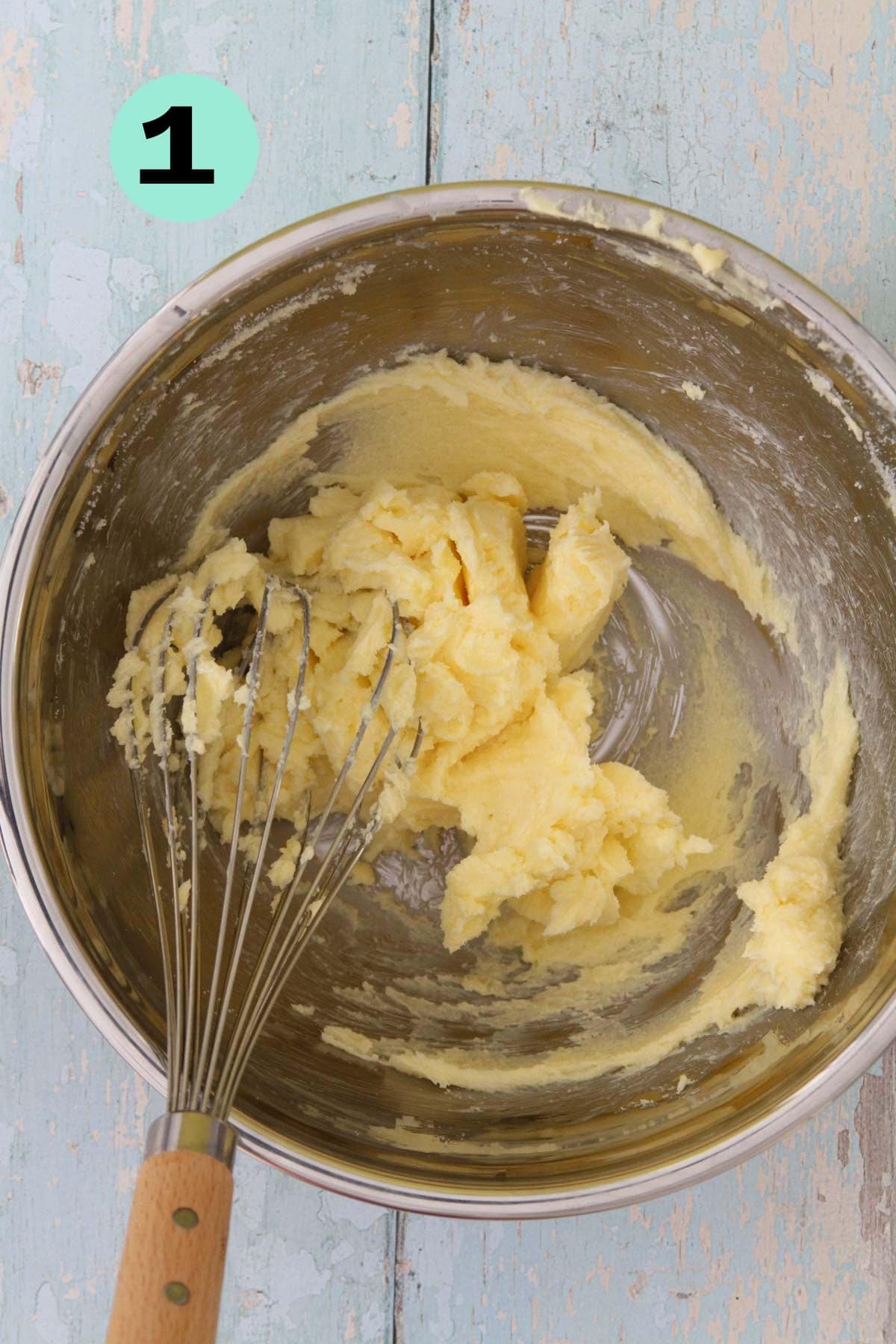
- In a bowl, cream the butter. If using lard, cream both the butter and the lard together. Add the sugar and cream until incorporated.
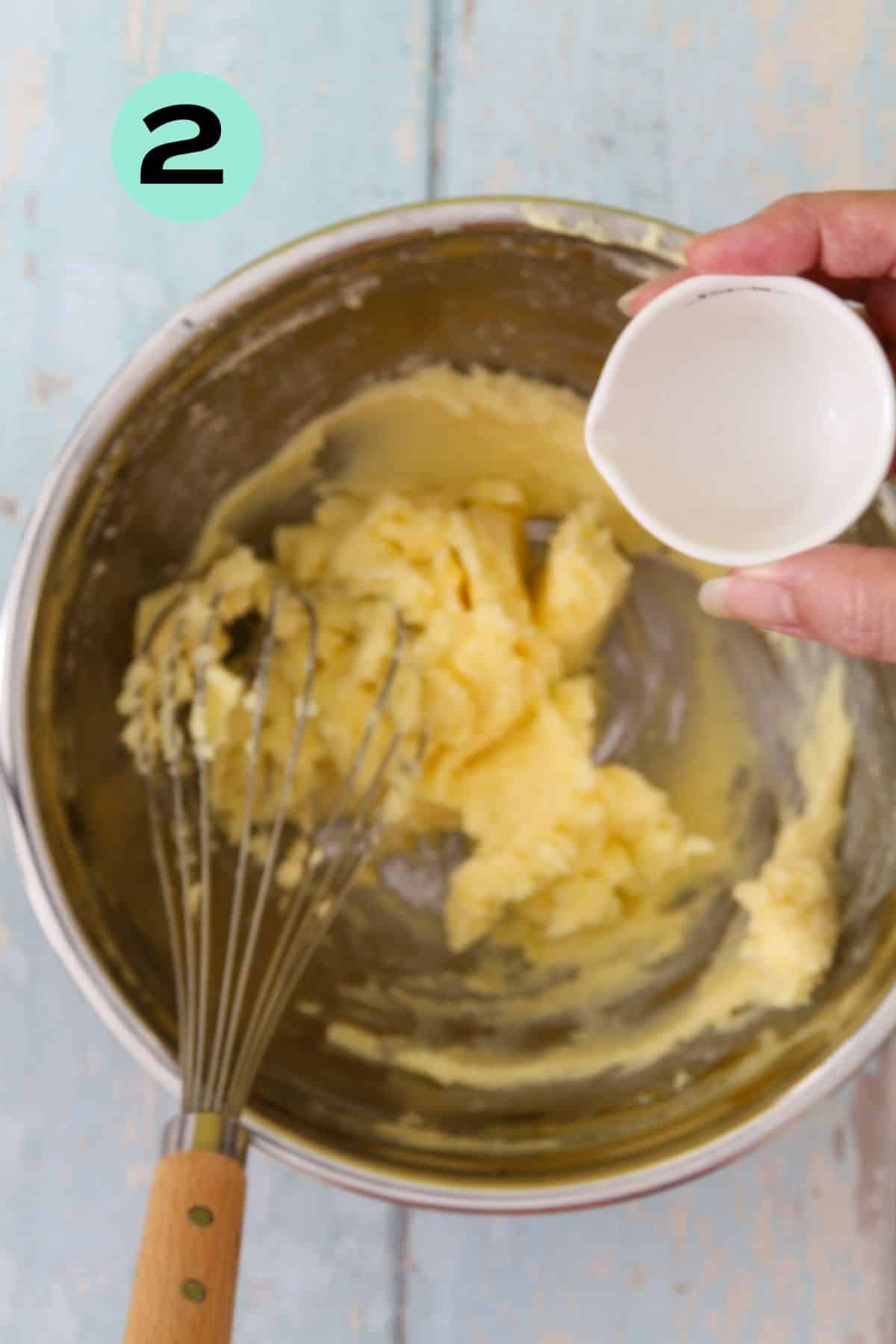
- Add the almond extract or desired flavoring.

- Add the flour and mix until combined.

- When done, the dough will have a sandy consistency, but it will hold its shape when rolled into a ball.

- With a small spoon, portion the dough and roll into balls with your hands. I use a #50 scoop, which both portions and shapes the dough. Place each ball on a baking sheet and press an indent into the center with a teaspoon.

- Guava paste is the preferred topping for these cookies. I use a very small round biscuit cutter so the guava fits neatly inside the indent. You can also use sprinkles or halved Maraschino cherries.

- Bake for about 20 minutes (oven temperatures vary, so be mindful of the suggested baking time) or until lightly golden around the edges. Transfer to cooling racks and let cool before serving.

Expert Tips
- Dough won't come together: Add a bit more fat, a tablespoon at a time. Incorporate it and test whether the dough holds its shape.
- Keep it simple: Do not overmix. Mix just until combined. Overworking the dough will make the polvorones tough instead of tender.
- Dough is too soft to handle: The culprit is usually overly softened or melted butter. Firm the dough in the fridge for 15 to 30 minutes before rolling. If it is still too soft, add flour a tablespoon at a time until you reach the right consistency.
- Uneven browning: Make sure all cookies are the same size and rotate the baking sheet halfway through baking.
- Storage: Once cooled, store polvorones in an airtight container at room temperature for up to a week. For longer storage, keep them in the refrigerator for up to a month. Let them rest at room temperature for a few minutes before serving to remove the chill and soften the cookie. Polvorones can be frozen in an airtight container for three months.
Recipe FAQs
Polvorones are traditional shortbread cookies from Estepa, Spain, that have transformed regionally throughout Latin America. They are known for their crumbly texture, buttery flavor, and mild sweetness. Some polvorones are dusted with powdered sugar, while others are not.
The original polvorones are mantecados dusted with powdered sugar. The name comes from the Spanish word polvo, meaning dust, and the suffix ón, meaning abundant, a cookie covered in an abundant amount of dust. Puerto Rican polvorones are not typically dusted with powdered sugar, but they kept the name. Both terms, polvorones and mantecados, are used interchangeably in Puerto Rico and parts of Spain.
Not quite, though they are cousins. What is widely known as the Mexican wedding cookie in America is actually called a polvorón in Mexico. These cookies follow the Arab cuisine tradition more closely, using ground nuts (hazelnuts or pecans) rather than the traditional almonds, and are rolled in powdered sugar after baking. By the Spanish definition, that makes them a true polvorón. Puerto Rico's version skipped both the nuts and the sugar coating, landing closer to a traditional mantecado.
Yes! In Estepa, polvorones and mantecado come in flavors such as cinnamon, almond, pine nuts, or sesame. Some of these are folded with the cookie dough, while others are placed on top of the cookie. Cuba adds lemon zest. The original inspiration, ghraybeh, is flavored with rosewater or orange blossom water. In Puerto Rico, we flavor the dough with almond or vanilla extract, and top ours with guava paste, sprinkles, Maraschino cherries, or coconut. But don't let those flavor choices limit your creativity.
To keep polvorones fresh, store them in an airtight container at room temperature for up to a week. For longer storage, they can be refrigerated for up to a month or frozen and thawed as needed for up to three months.
Absolutely! You can prepare and refrigerate the dough for up to 3 days before baking. Baked cookies can also be made in advance and stored for later enjoyment.

More Desserts, Sweets, and Breads
- Pumpkin spice coquito
- Low-Carb Polvorones
- Puerto Rican Spice Cake (Hojaldre Añasqueño)
- Peanut Butter Blondies

I'd love to hear from you! Did you try this recipe? Leave a review and rating below. Let's connect on Instagram, and don't forget to join my weekly email list for fresh new recipes.
📖 Recipe

Puerto Rican Polvorones
Ingredients
- ¼ pound butter
- ½ cup lard or additional stick of butter if not using lard
- ½ cup sugar
- 1 teaspoon almond extract
- 2 ¼ cups flour
- 1 oz guava paste optional for decoration
- 1 oz colored sprinkles optional for decoration
- 15 Maraschino cherries halved optional for decoration
Instructions
- Leave the butter and, if using, the lard on the counter and let it come to room temperature. Lard can take a bit longer to soften, so make sure both are nice and soft before creaming. Harder butter or lard will keep the dough from coming together. Preheat the oven to 350℉ and place the oven rack in the center.
- In a bowl, cream the butter. If using lard, cream both the butter and the lard together. Add the sugar and cream until incorporated.¼ pound butter, ½ cup lard, ½ cup sugar
- Add the almond extract or desired flavoring.1 teaspoon almond extract
- Add the flour and mix until combined.2 ¼ cups flour
- When done, the dough will have a sandy consistency, but it will hold its shape when rolled into a ball.
- With a small spoon, portion the dough and roll into balls with your hands. I use a #50 scoop, which both portions and shapes the dough. Place each ball on a baking sheet and press an indent into the center with a teaspoon.
- Guava paste is the preferred topping for these cookies. I use a very small round biscuit cutter so the guava fits neatly inside the indent. You can also use sprinkles or halved Maraschino cherries.1 oz guava paste, 1 oz colored sprinkles
- Bake for about 20 minutes (oven temperatures vary, so be mindful of the suggested baking time) or until lightly golden around the edges. Transfer to cooling racks and let cool before serving.

Notes
About Lard:
- Never buy your lard from the shelf of an aisle in a major grocery store. These shelf-stable products tend to be hydrogenated and linked to trans fats, which we want to avoid.
- Please find a local farmer who renders fat from their pigs. Not only will you get a better, fresher product, but you will also be supporting your local community. I buy my lard from a reputable organic farm a few miles from home. The lard is rendered and canned in a mason jar at the farm, then kept refrigerated.
- Prevention has a great article on the use of lard and its health benefits.
- Beef tallow is harder and crisper than lard. It takes longer to soften and does not behave as creamily as pork lard. If you are planning on using tallow, cut the tallow amount in half and increase the butter ratio.
Expert Tips
- Dough won't come together: Add a bit more fat, a tablespoon at a time. Incorporate it and test whether the dough holds its shape.
- Keep it simple: Do not overmix. Mix just until combined. Overworking the dough will make the polvorones tough instead of tender.
- Dough is too soft to handle: The culprit is usually overly softened or melted butter. Firm the dough in the fridge for 15 to 30 minutes before rolling. If it is still too soft, add flour a tablespoon at a time until you reach the right consistency.
- Uneven browning: Make sure all cookies are the same size and rotate the baking sheet halfway through baking.
- Storage: Once cooled, store polvorones in an airtight container at room temperature for up to a week. For longer storage, keep them in the refrigerator for up to a month. Let them rest at room temperature for a few minutes before serving to remove the chill and soften the cookie. Polvorones can be frozen in an airtight container for three months.