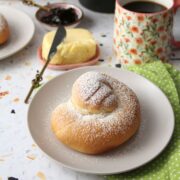
Pan de Mallorca
Pan de Mallorca is Puerto Rico's best-kept baked secret, as rich as brioche and as soft and sweet as a Hawaiian roll.
Servings: 12 rolls
Calories: 321kcal
Equipment
Ingredients
- 3½ cup flour all-purpose-420g
- ⅓ cup sugar 67g
- 1 packet active dry yeast (2.25 tsp-7g)
- ¾ teaspoon salt 4g
- ¾ cup milk warm, around 100°F, 180ml
- 2 sticks butter soften and divided. 6 tablespoon for dough, rest for bruhing. 85g
- 1 tablespoon vanilla
- 1 tbs honey 21g
- 2 large eggs plus one extra egg yolk
Instructions
- Reserve extra butter to spread on the dough before forming the rolls. You will need a parchment paper-lined sheet pan or cookie sheet for final proofing and baking. The oven will be preheated during the second proof. If you plan to use an egg wash for a more golden finish, whisk 1 egg with a splash of milk and set aside.
- Activate the yeast: In a small bowl, mix warm milk, yeast, and honey. Let it sit for about 10 minutes, until foamy.1 packet active dry yeast, ¾ cup milk, 1 tbs honey
- Mix dry ingredients: In the bowl of a stand mixer, whisk together the flour, sugar, and salt.3½ cup flour, ⅓ cup sugar, ¾ tsp salt
- Start the dough: Add the yeast mixture and eggs to the dry ingredients. Mix on low speed with the dough hook until a sticky dough forms.2 large eggs
- Incorporate the butter and the vanilla: With the mixer running on medium-low speed (Speed 2), gradually add the softened butter. Knead for 8-10 minutes, until the dough is smooth and elastic, and pulls from the sides of the bowl. If the dough is still very loose, add flour 1 tablespoon at a time as needed. Make sure the flour is fully incorporated before adding more.2 sticks butter, 1 tbsp vanilla
- First proof (start): Transfer the dough to a lightly greased bowl.
- Cover the dough: Cover with plastic wrap or a damp towel. A friend of mine uses a dedicated shower cap to cover the bowl and proof the dough.
- First proof (finished): Let rise for 1½-2 hours, until doubled in size.
- Deflate and rest: Gently deflate the dough and return it to the bowl to prepare for shaping.
- Divide the dough: Weigh and portion the dough into 2-ounce pieces for smaller rolls or 4-ounce pieces for larger rolls.
- Rest the portions: Cover the dough portions with a clean kitchen towel and let them rest briefly to relax the gluten.
- Roll and butter: Roll each portion into a small rectangle and lightly spread with softened butter (or filling, if using).
- Roll into logs: Tightly roll the dough into a log.
- Shape the Mallorcas: Coil each log into a spiral shape.
- Second proof: Place the shaped rolls on a parchment-lined baking sheet, about 2 inches apart. Cover and let rise for 45-60 minutes. Preheat the oven to 350℉.
- Ready to bake: The rolls should look puffy and relaxed. Brush with egg wash if using.
- Bake and finish: Bake at 350℉ for 15-18 minutes, rotating the pan halfway through for even baking. Brush with melted butter while still warm, then dust with powdered sugar once cooled before serving.
Notes
- If your dough seems too soft or spreads too thin, it likely needs more flour or a longer kneading time. Look for a dough that’s tacky but clears the sides of the bowl.
- Milk temperature matters: Warm the milk to about 98°F. Milk that’s too cold won’t allow the yeast to bloom, and milk hotter than 98°F (or colder than 37°C) can kill the yeast. If heating, let it rest briefly before using.
- Don’t rush the dough: Make sure the flour is fully incorporated before adding more. Adding excess flour too early can lead to tough, dense rolls.
- Weigh for consistency: Weigh your dough portions to ensure even size and uniform baking, especially important when shaping spiral rolls.
- Butter creates texture: Spreading softened butter before rolling helps create subtle layers and contributes to the soft, rich crumb.
- Watch the oven, not the clock: Use an oven thermometer if possible. Overbaking is the fastest way to dry out enriched doughs like Pan de Mallorca.
- Let the rolls cool before dusting: If you dust them with powdered sugar while they're still hot, the sugar will melt instead of coating the surface.
- Plan ahead: Baked rolls or shaped dough can be frozen after the first rise. Wrap tightly and thaw overnight before baking or reheating.
Nutrition
Serving: 4oz | Calories: 321kcal | Carbohydrates: 36g | Protein: 6g | Fat: 17g | Saturated Fat: 10g | Polyunsaturated Fat: 1g | Monounsaturated Fat: 4g | Trans Fat: 1g | Cholesterol: 73mg | Sodium: 285mg | Potassium: 86mg | Fiber: 1g | Sugar: 8g | Vitamin A: 540IU | Vitamin C: 0.01mg | Calcium: 34mg | Iron: 2mg
