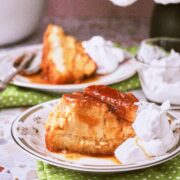
Flancocho
Flancocho is the dessert Puerto Ricans bring out when they want to make an impression. A layer of silky vanilla flan rests atop a cake layer, all held together by a deep-amber caramel that runs down the sides.
Servings: 10 servings
Calories: 708kcal
Equipment
- 1 roasting pan or a large pan to hold the cake pan for the flan
- 1 hand whisk
- 1 hand mixer
- 1 Cake Pan
- 1 small saucepan for caramel
- 1 medium saucepan for water
Ingredients
For Caramel
- 1 cup granulated sugar 200 g
- ¼ cup water 60 ml
For Cake
- 2½ cups all-purpose flour 315 g
- 2½ teaspoon baking powder
- ½ teaspoon salt
- ¾ cup unsalted butter softened. 170 g
- 2 cups granulated sugar 400 g
- 4 large eggs room temp
- 1 tablespoon vanilla extract
- 1 cup whole milk room temp. 240 ml
For Flan
- 1 can sweetened condensed milk (14 oz / 397 g)
- 1 can evaporated milk (12 oz / 354 ml)
- 4 large eggs room temp
- 1 tablespoon vanilla extract
Instructions
Making Caramel
- Preheat the oven to 350℉ (175℃). Grease your Bundt or tube pan well, paying attention to all the grooves.
- In a small saucepan, combine sugar and water over medium heat. cook, swirling occasionally (no stirring), until golden amber. Quickly pour into the bottom of your pan, tilting to coat evenly. Set aside to cool and harden.1 cup granulated sugar, ¼ cup water
Making the cake batter
- Mix the dry ingredients. In a bowl, mix together flour, baking powder, and salt.2½ cups all-purpose flour, 2½ tsp baking powder, ½ tsp salt
- Cream butter and sugar. In a large bowl, beat butter and sugar until light and fluffy, about 3 minutes.¾ cup unsalted butter, 2 cups granulated sugar
- Add eggs and vanilla. Beat in eggs one at a time, then add vanilla.4 large eggs, 1 tbsp vanilla extract
- Alternate wet and dry ingredients. Add flour mixture in 3 parts, alternating with milk in 2 parts, starting and ending with flour. Mix just until combined. Set aside.1 cup whole milk
Making the flan mixture and assembly
- Blend condensed milk, evaporated milk, eggs, and vanilla until smooth. Pour flan mixture over the cooled caramel in the pan.1 can sweetened condensed milk, 1 can evaporated milk, 4 large eggs, 1 tbsp vanilla extract
- Carefully pour the yellow cake batter over the flan mixture. The layers will naturally separate as they bake.
- Place your pan inside a larger roasting pan. Add hot water to the outer pan until it reaches halfway to the sides of your cake pan. Bake for 60-75 minutes, or until a toothpick inserted into the cake layer comes out clean.
- Remove from the water bath and cool completely. Refrigerate for at least 4 hours or overnight. Run a thin knife around the edges, then invert onto a large serving plate.
Notes
EXPERT TIPS
- Don't skip the water bath. The flan needs indirect, gentle heat to set properly. Without it, the eggs cook too fast, the flan turns grainy, and the layers won't separate cleanly.
- Cool the caramel before adding the flan. If the caramel is still warm when you pour in the flan mixture, it will start cooking the eggs at the bottom before the pan even goes in the oven. Give it at least 15 minutes.
- If your caramel seizes and hardens into chunks, don't panic. Keep the heat on medium-low and keep swirling — the clumps will re-melt. It happens to everyone at least once.
- Grease the walls of the bundt pan even after the caramel goes in. The caramel coats the bottom, but the cake batter will stick to the uncoated sides if you don't butter them.
- Refrigerate overnight if you can. The texture of both layers improves significantly after a full night in the fridge. The flan firms up, the flavors meld, and the cake becomes more tender as it absorbs a little of the caramel moisture.
- Use a plate larger than your bundt pan. When you flip, caramel is going to run and pool. A plate that's too small will send it right over the edge.
Nutrition
Serving: 4oz | Calories: 708kcal | Carbohydrates: 109g | Protein: 15g | Fat: 26g | Saturated Fat: 14g | Polyunsaturated Fat: 2g | Monounsaturated Fat: 7g | Trans Fat: 1g | Cholesterol: 212mg | Sodium: 379mg | Potassium: 355mg | Fiber: 3g | Sugar: 88g | Vitamin A: 871IU | Vitamin C: 2mg | Calcium: 341mg | Iron: 2mg
